Tankless hot water, honestly: what Rinnai does well and who should not bother
Endless hot water is real. So is the gas line, the venting and the water hardness it needs to actually deliver on that promise.
September 16, 2026 · 4 min read
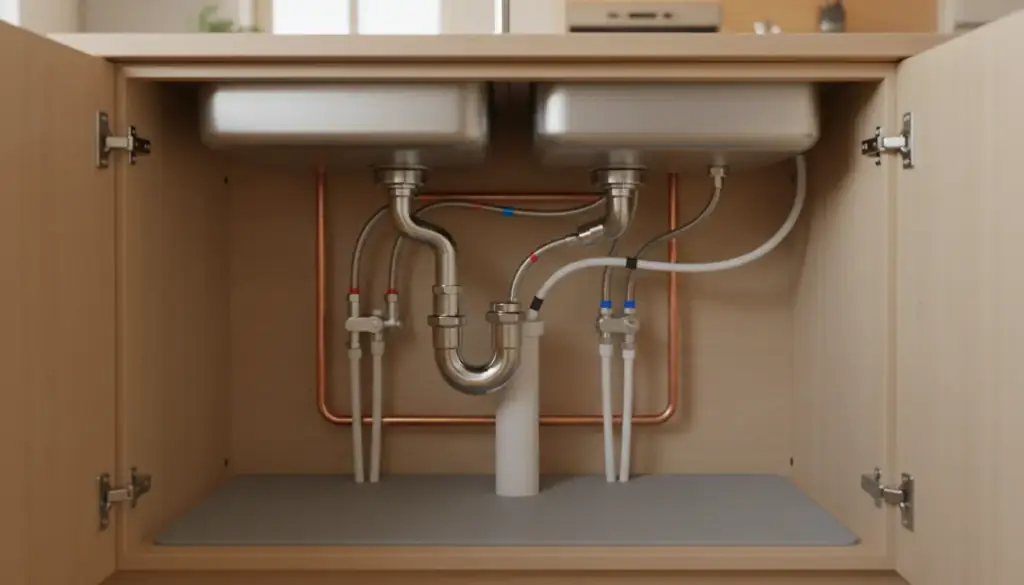
As a certified Rinnai dealer we install a lot of tankless water heaters, and the honest version of that pitch includes what the house has to give up as well as what the homeowner gets back. Tankless is a real improvement for the right house. It is not a drop-in upgrade for every house, and pretending otherwise is how people end up disappointed with a good piece of equipment.
What tankless actually does well
A tankless unit heats water on demand rather than storing sixty gallons of it at temperature around the clock, which means it does not run out midway through a shower the way a tank can when the household is stacking showers, laundry and a dishwasher back to back. It also gets a bulky tank out of a utility closet or basement corner, which matters in a smaller mechanical room. Both of those are real, not marketing.
What it needs: the gas line
A tankless unit has a much higher instantaneous gas demand than a standard tank water heater, because it is heating water fast rather than slowly over hours. That means the gas line feeding it, and sometimes the meter or regulator itself, has to be sized for that load. This is the single most common thing that gets missed when someone installs a tankless unit without checking it first, and it is the difference between a unit that performs the way it should and one that struggles under real demand.
What it needs: the venting
Tankless units vent differently from a standard tank, almost always through dedicated PVC intake and exhaust rather than a shared chimney, and the venting has to be run to the manufacturer's length and termination rules exactly. This is not the kind of thing to shortcut with whatever pipe happens to be on the truck. Getting it wrong shows up later as poor performance or nuisance shutdowns, not as an immediate obvious failure.
What it needs: the water
This is the part that matters most for a lot of houses in this county, because so many are on well water. Hard water scales the inside of a tankless heat exchanger the same way it scales a kettle, and a tankless heat exchanger is a much smaller, tighter space than a tank, so scale affects it faster. A tankless unit on hard well water without treatment needs more frequent descaling, typically an annual flush, to keep performing and to protect the warranty. On genuinely hard, untreated well water, that maintenance is not optional, and it is worth factoring into the real cost of ownership before installing.
What it needs: electricity
A tank water heater will still produce hot water in a power outage as long as the gas or oil supply to it keeps running, because there is no electronic ignition standing between the burner and the tank. A tankless unit needs electricity to run its control board and ignition every single time it fires, since there is no standing pilot and no stored reserve of hot water to fall back on. In a house that loses power occasionally, that is worth knowing before assuming hot water is a given no matter what.
How sizing actually works
Tankless units are rated by how many gallons per minute they can heat to a given temperature rise, not by a storage capacity the way a tank is. Groundwater coming into a house in an upstate New York winter is cold, which means the unit has to work harder for the same flow than it would heating water that started out warmer, and that lowers its effective output exactly during the season hot water gets used the most. Sizing a tankless unit off a summer flow rate, rather than a real winter temperature rise, is one of the more common reasons a household ends up disappointed by a unit that was never actually large enough for their real demand.
Who should probably not bother
A single person or couple with modest hot water demand and no hard water problem often will not see enough benefit to justify the cost difference over a good standard tank, particularly an indirect tank running off an existing boiler, which is already efficient in a hydronic house. A house with genuinely hard well water and no interest in adding a water softener or filtration is taking on a maintenance commitment that a lot of homeowners underestimate going in. And a house where the existing gas service is already close to its limit may need a broader gas supply upgrade before tankless is even on the table, which changes the economics of the whole decision.
The honest bottom line
Tankless is a genuine upgrade for a household that runs out of hot water regularly, wants the space back, and either has soft water or is willing to treat it. It is not automatically the right answer just because it is newer, and a good indirect tank off an existing boiler is still the better call in plenty of houses in this county. Worth a real conversation about your specific water and your specific gas service before deciding either way.
Dan's Heating & Cooling Inc., 518-339-6534
Call 518-339-6534More articles
A boiler is a twenty year decision. Here is what actually makes one last that long.
Cast iron, near-boiler piping and hard well water do more to decide a boiler's lifespan than the sticker on the front of it.
Air conditioning for a house with no ductwork: high-velocity or ductless, and how to actually decide
Two real ways to cool a house that was never built for ducts, and the questions that actually decide which one is right for yours.